
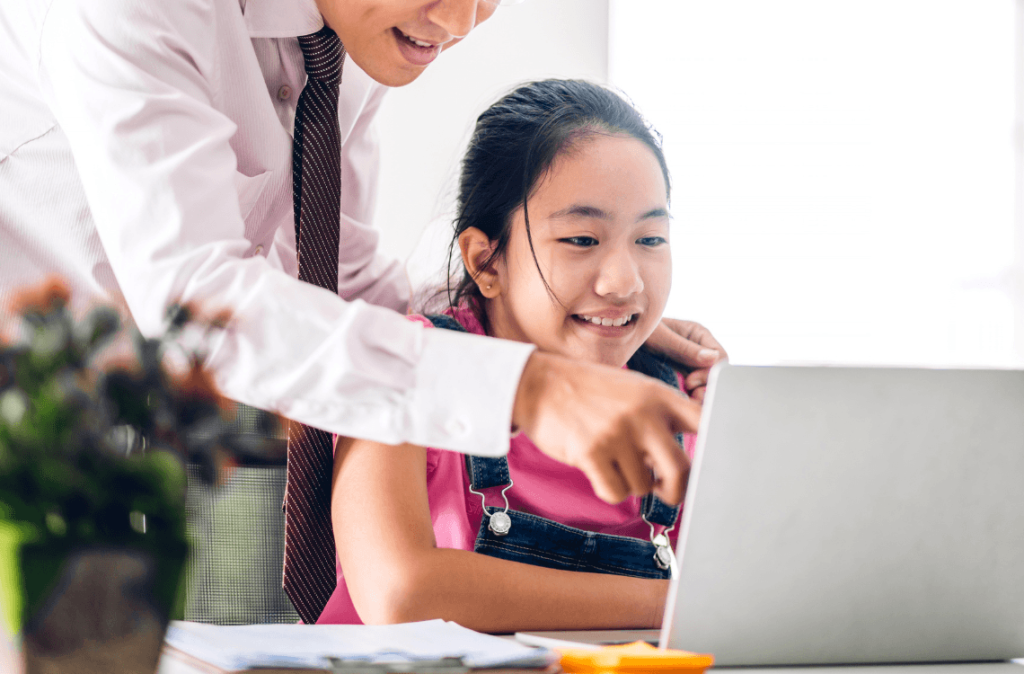
Short answer: AI tools such as ChatGPT can support children’s learning when used responsibly, but they should not replace a child’s own thinking, learning or schoolwork. Singapore’s Ministry of Education (MOE) provides guidance for parents on the responsible use of generative AI, alongside its broader AI-in-education framework. MOE’s guidance on generative AI explains how parents can support their children’s responsible use of these tools.
If your child has started asking ChatGPT to explain homework, generate ideas or answer questions, you’re certainly not alone.
Generative AI is becoming part of children’s learning environments, and Singapore schools are also preparing students for an AI-transformed future. MOE says AI literacy is being integrated into the curriculum, co-curriculum and self-directed learning resources, while Cyber Wellness lessons include skills such as validating information generated by AI and identifying deepfakes. MOE’s 2026 Committee of Supply announcements provide more details.
For parents, the question is no longer simply whether children will encounter AI. It is how they can learn to use it safely and responsibly.
Can Children Use ChatGPT For Homework?


Yes, but how they use it matters.
AI can be useful for explaining a difficult concept, generating practice questions, brainstorming ideas or offering another way to understand something a child has already learnt.
However, asking AI to complete an assignment from start to finish can take away an important part of learning: working through a problem independently.
A useful rule at home is to encourage children to think first, ask AI second and check the answer afterwards.
For example, instead of asking ChatGPT to write an entire composition, a child could use it to brainstorm possible ideas, identify areas that need improvement or explain why a particular sentence does not work.
What Are The Risks Of Children Using Generative AI?
AI-generated answers can sound convincing even when they are inaccurate, incomplete or unsuitable.
MOE’s current guidance notes that generative AI presents both opportunities and challenges and says these tools are most useful when students have already mastered basic concepts and thinking skills.
Parents should therefore help children understand three important things:
1. AI Can Be Wrong
A confident-sounding answer is not automatically a correct one.
Encourage your child to check important information against their textbook, school materials, teacher or reliable sources rather than accepting an AI response immediately.
2. AI Should Not Do The Thinking For Them
If a child routinely asks AI to solve every difficult question, they may miss the opportunity to develop problem-solving and critical-thinking skills.
Try asking, “What do you think the answer is first?” before turning to AI.
3. Children Should Protect Their Personal Information
Remind children not to enter sensitive personal details, passwords, private conversations or identifying information into AI tools.
You can also encourage them to ask before uploading photographs, school documents or other material they are unsure about sharing.
How Can Parents Teach Responsible AI Use At Home?

You do not need to become an AI expert yourself.
Instead, make AI use something your family can discuss openly.
Try these simple habits:
- Ask your child to show you how they use AI. This gives you a better idea of what they are actually doing.
- Check answers together. Ask, “How could we verify this?”
- Encourage original thinking. Have your child attempt a question before asking AI.
- Discuss AI-generated content. Talk about why a realistic-looking image, video or answer may not necessarily be true.
- Set boundaries around schoolwork. Follow your child’s school’s expectations about acceptable AI use.
- Focus on learning, not just getting an answer. The goal should be understanding the subject.
MOE’s updated parent resources on AI in education specifically encourage parents to learn about generative AI and support their children’s responsible use of these tools.
Should Parents Ban ChatGPT For Children?

A blanket ban is not the only way to approach AI.
Children are growing up in a world where AI is increasingly part of education and everyday technology. Helping them develop good judgement may be more useful than simply avoiding the technology altogether.
The better question may be: “Can my child explain what they used AI for, check whether the information is reliable and still do the thinking themselves?”
That is a skill they can carry into school, work and everyday life.
FAQs About Children And ChatGPT
Is ChatGPT Safe For Children?
AI tools have potential benefits and risks, and suitability depends on the child’s age, maturity and how the tool is being used. Parents should supervise younger children and follow the relevant platform and school guidance.
Can Students Use ChatGPT For Homework?
AI may support learning, such as explaining concepts or brainstorming, but students should follow their school’s rules and should not rely on AI to complete work that is meant to demonstrate their own understanding.
How Can Parents Tell If An AI Answer Is Wrong?
Ask children to cross-check important information with trusted sources such as school materials, teachers and official websites. AI-generated information should not automatically be treated as fact.
What Should Parents Teach Children About AI?
Start with four basics: think before asking, protect personal information, check AI-generated information and keep their own voice and thinking in their work.
For Singapore parents, the goal is not to make children afraid of AI. It is to help them become thoughtful users who know when to use it, when to question it and when to put the technology aside.
Disclaimer: The information provided in this article is for informational purposes only and should not be considered as medical advice from Motherhood. For any health-related concerns, it is advisable to consult with a qualified healthcare professional or medical practitioner.
For more insightful stories and parenting advice, stay tuned to Motherhood.sg!