
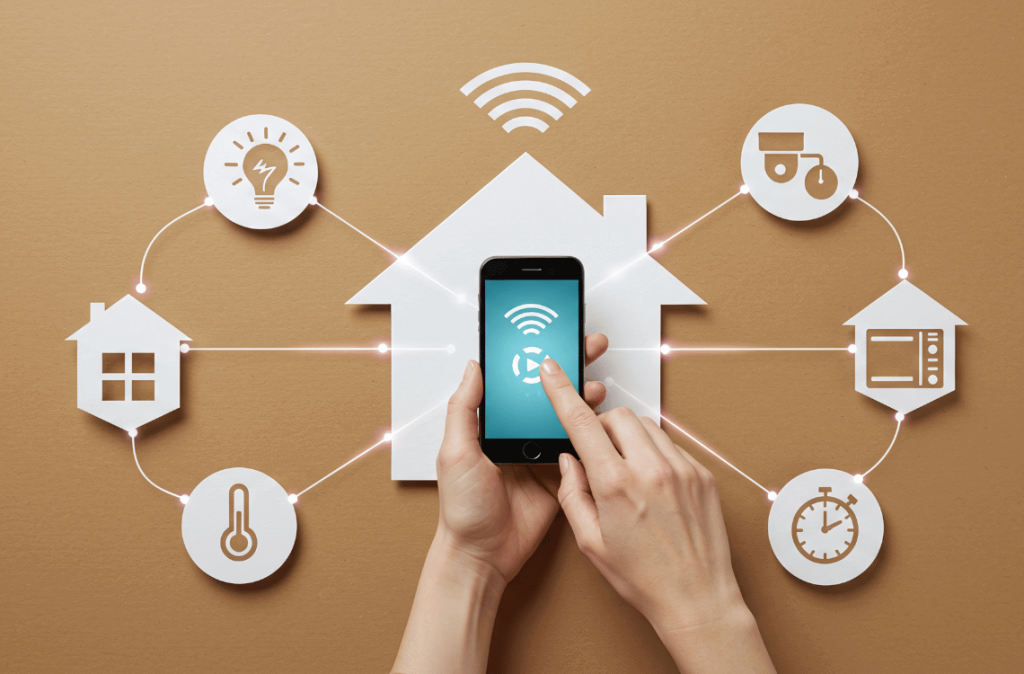
From voice-activated virtual assistants that obey your every command to home cameras that monitor your child’s every move, the rise of smart homes is a privilege that many families have come to know in recent years.
But as these gadgets get smarter, the question grows louder: how much of our home life are we quietly handing over to machines?
Here’s what you need to know about smart homes before you start ‘plugging in’.
The Rise of the Hyper-Connected Home


Over the last decade, smart home cameras and baby monitors have evolved from grainy, static-prone devices to ultra-sharp, app-linked companions that track almost everything.
Sleep cycles, breathing patterns, room temperature, even whether your child has done their homework or not.
Major brands now boast AI-powered alerts, facial recognition, and cloud-based recordings.
Some even offer movement heat maps and insights into your child’s sleep quality, like a Fitbit for tiny humans.
It’s impressive, yes. But it’s also a bit unnerving when you think about it.
Recent consumer reports across Asia have shown a surge in adoption of smart home monitoring systems, with more families citing safety and convenience as the main draw.
A Straits Times article earlier this year highlighted how more parents are using indoor cameras not just for babies, but also to keep an eye on helpers at home.
Another CNA report explored concerns over unsecured home cameras being hacked. An issue that sent many parents scrambling to change their passwords.
The Allure of “Always On” Parenting

Convenience Wrapped in Technology
Let’s be honest: parenting is exhausting. The promise of being able to watch your baby sleep from your phone while heating up a bottle—or while hiding in the corridor for two minutes of peace—is irresistible.
Smart homes equipped with monitors make it possible to juggle chores while keeping tabs on your child’s safety, and they help anxious first-time parents feel more in control of the unknown.
Unlike older monitors that crackled with every passing motorcycle, modern systems are smooth, silent, and wonderfully crisp.
You can be in the living room and still feel connected to what’s happening in the nursery without hovering over the crib like a slightly paranoid guardian angel.
Data-Driven Peace of Mind
Many devices now offer analytics. For some parents, this is genuinely transformative. If your baby’s sleep patterns look choppy, the data gives you clues.
If the room gets too warm or too cold, you get an alert. It’s practical. It’s helpful. It’s also, admittedly, very cool.
But here’s the trade-off: to get these features, many devices store data in the cloud, meaning your child’s sleep logs, audio recordings, and video clips might be sitting on a server somewhere.
The Hidden Costs: Privacy in a Smart Home

Where Does All That Footage Go?
This is the question many parents forget to ask until something goes wrong. It’s easy to assume that baby monitor footage disappears into the ether.
In reality, many brands store video files for days or weeks. Some require cloud subscriptions to function fully.
In 2023, a widely reported incident overseas involved a baby monitor stream being accessed by an unknown third party—a chilling reminder that anything connected to the internet can be vulnerable.
More recently, cybersecurity researchers found vulnerabilities in several popular home camera systems, prompting news outlets to publish cautionary pieces urging families to secure their devices properly.
Surveillance Fatigue—But For Parents
There’s another layer to all this: the psychological effect.
When you’re constantly watching your child through a screen, you might unintentionally start monitoring every movement, every noise, every wiggle.
Hypervigilance becomes the default.
Some parenting experts warn that over-reliance on constant monitoring can heighten parental anxiety rather than reduce it.
A well-intentioned glance at the app can spiral into an hour of checking and rechecking because the analytical graph dipped slightly at 4:12 a.m.
Safety Vs Sanity

A Balancing Act
There’s no denying the benefits—enhanced safety, convenience, and analytics. But equally, there’s no escaping the reality that cameras inside the home change the environment. They shift the energy.
Someone is always watching, even if that someone is you.
If your home has domestic helpers, there’s the additional question of consent and trust. Some people feel safer with cameras; others feel uncomfortable being monitored during their daily routines.
It’s important to consider how these devices impact all members of the household, not just the children.
Minimising Risk
- If you want the perks but not the privacy pitfalls, several steps can help:
- Use strong passwords and change them regularly.
- Keep the camera’s firmware updated.
- Choose brands with robust encryption standards.
- Avoid placing cameras in overly sensitive areas.
- Disable cloud storage if you don’t truly need it.
These aren’t glamorous solutions, but they’re effective.
The Future of Home Monitoring

Smarter Devices, Smarter Parents
The home-monitoring industry is expanding quickly. Next-generation baby monitors are already being tested with biometric sensors and predictive algorithms. Some brands are experimenting with heartbeat and oxygen-level scanning—with no physical contact at all.
As technology races ahead, families will increasingly have to decide how much visibility they want versus how much data they’re willing to part with. And that decision won’t always be straightforward.
Creating a House That’s Safe, Not Stressful
The goal is to create a nurturing environment, not a digital panopticon. If the gadgets are helping you relax, great. If they’re making you feel like you’re running a miniature control centre worthy of a sci-fi film, it might be time to scale back.
Ultimately, all parents want the same thing: to know their kids are safe, healthy, and sleeping soundly (preferably for more than 90 minutes at a time).
Cameras and smart monitors can absolutely help—but they shouldn’t replace trust, intuition, and good old-fashioned human presence.
Hyperconnection Vs Family Connection

Smart homes can be lifesavers, offering reliable reassurance and convenient oversight.
But they also come with privacy trade-offs that families should think through carefully. Technology can support you, but it shouldn’t overwhelm your household or your peace of mind.
Finding a balance—between safety and serenity, between convenience and caution—is the key to making these tools work for you rather than the other way around.
Disclaimer: The information provided in this article is for informational purposes only and should not be considered as medical advice from Motherhood. For any health-related concerns, it is advisable to consult with a qualified healthcare professional or medical practitioner.
For more insightful stories and parenting advice, stay tuned to Motherhood.sg!